
 Nurhidayah Mahmood
It’s Friday afternoon, and your sales manager asks a simple question: “Where are we with the big deal?” One salesperson opens a spreadsheet. Another scrolls through three weeks of WhatsApp chats. A third says, “Let me call the client and check.”
Nobody can give a clear answer. Then, a month later, your best salesperson resigns. Her phone, and every client conversation on it, leaves with her.
This is a familiar story for many Malaysian businesses still looking for the right CRM. Excel and WhatsApp are easy, familiar tools, and most teams start with them for good reason. But as the team grows, they quietly start to cost you deals.
5 Signs Your Sales Team Has Outgrown Excel and WhatsApp
If two or more of these sound familiar, it may be time to look at a CRM:
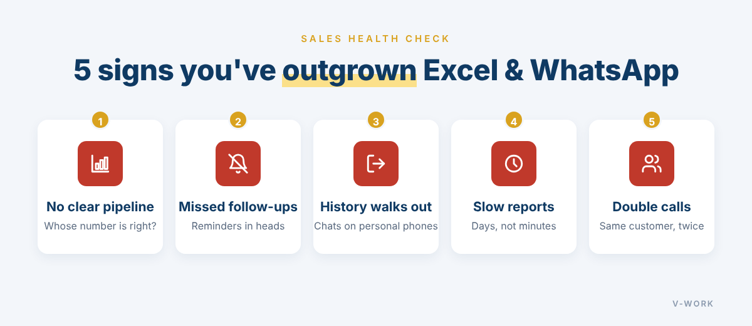
- No clear pipeline. Each salesperson keeps their own list, so the total changes depending on who you ask.
- Missed follow-ups. Reminders live in people’s heads. A quotation goes out, and nobody calls back.
- Customer history walks out the door. Contacts, chats and notes sit on personal phones. When someone resigns, the relationship goes with them.
- Reports take days, not minutes. Month-end means chasing everyone for numbers and merging files by hand.
- Two salespeople call the same customer. Without one shared record, the customer gets mixed messages and your team looks disorganized.
Why This Matters More Than It Seems
Lost deals are hard to see. Nobody reports “the follow-up we forgot.” The deal just goes quiet, and a competitor wins it.
There is also a data question. Customer names, phone numbers and IC copies shared in chats are personal data. Malaysia’s Personal Data Protection Act (PDPA) requires companies to take practical steps to protect personal data, and since 2025, to report data breaches. That is much harder when the data is spread across personal phones and private spreadsheets.
What a CRM Changes
A CRM (customer relationship management) system keeps every customer, deal and conversation in one shared place that the company owns. With Microsoft Dynamics 365 Sales, Malaysian sales teams can:
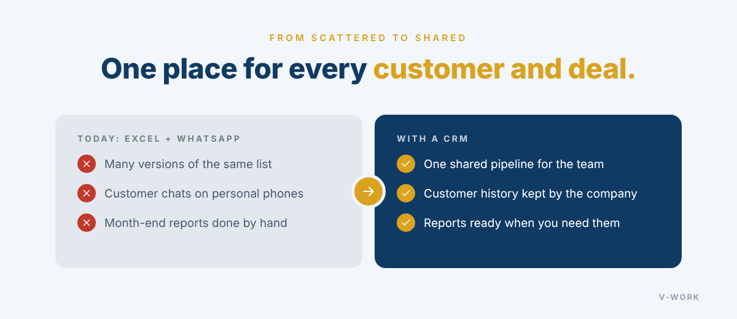
- See every lead and deal in one place, by stage, so the whole team sees the same numbers.
- Set follow-up tasks and reminders, so no quotation is left hanging.
- Keep customer history in the company’s system, not on personal phones.
- Track emails and meetings from Outlook without typing them again.
- Update deals on the go with the mobile app.
What about WhatsApp? Many Malaysian customers will still prefer it, and that’s fine. Your team can keep chatting on WhatsApp and record the key points against the customer in the CRM. Connecting WhatsApp directly to Dynamics 365 is possible, but it needs an extra add-on and a messaging provider, so plan for it if you need it.
Dynamics 365 Sales also comes in several editions. The features above are core sales features. AI (Copilot) features and sales forecasting come with the higher editions, so check which edition fits your team before you start.
How to Start Without Disrupting Your Team
- Start small. Pick one team and one process first, for example from new lead to quotation.
- Bring your data in. Clean up your existing Excel lists before you import them, so the CRM starts with good data.
- Keep it simple. Agree on the few fields that really matter. A simple CRM that people use beats a perfect one that nobody updates.
Excel and WhatsApp helped your business get this far. A CRM helps it grow without losing track of customers, deals or the people behind them.
Ask yourself one question this week: if your best salesperson left tomorrow, how much customer history would leave with them?