
 Nurhidayah Mahmood
It’s Monday morning. Your sales executive sends a client proposal that was written with help from AI. It looks polished and professional. Two days later, the client calls: the price in the summary doesn’t match the price in the table, and one paragraph mentions a service your company doesn’t offer.
The executive says, “AI wrote that part.” The manager says, “I didn’t see the final copy.” The boss asks the question nobody wants to answer: who is responsible?
This is becoming a common story as more companies start using AI at work. It’s a new kind of mistake. It comes from a machine but goes out under your company’s name.
The Uncomfortable Truth: AI Cannot Take the Blame
AI can write, summarize and fill in forms in seconds. What it can’t do is be held accountable. A client won’t accept “the AI did it” as an excuse, and neither will a regulator. For example, if a client’s personal details end up in the wrong document, Malaysia’s PDPA still holds your company responsible, whatever tool was used.
So the real question isn’t whether AI makes mistakes, because it will. The question is whether your company has a way to catch them before they leave the office.
Where AI Mistakes Usually Hide
AI mistakes are tricky because they look confident. The writing reads well, so people skim it and trust it. Most errors fall into five places:
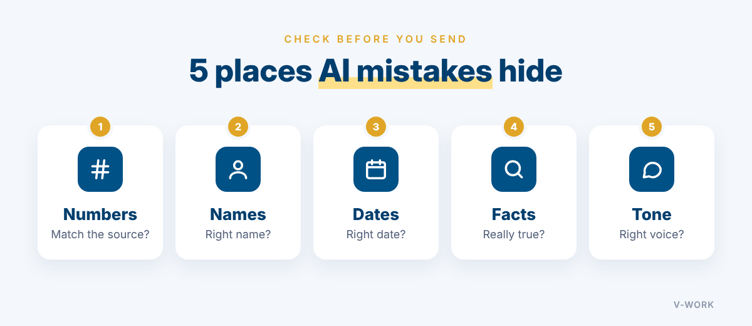
- Prices, totals and percentages that don’t match the source.
- The wrong client, product or person.
- Deadlines, contract periods or meeting dates that are slightly off.
- Details the AI “filled in” because they sounded right, but that aren’t true.
- Wording that’s too casual for a government client, or too stiff for a long-time partner.
Why “Just Be Careful” Doesn’t Work
Many companies respond by telling staff to “check properly.” That rarely works. People are busy, AI output looks finished, and nobody knows who was supposed to check what.
The problem isn’t careless staff. The problem is that there’s no clear step where a human checks the work, and no record of who approved it.
A Simple Fix: AI Drafts, a Human Decides
A simple rule helps: AI can prepare, but only a named person can approve. In practice, it looks like this:
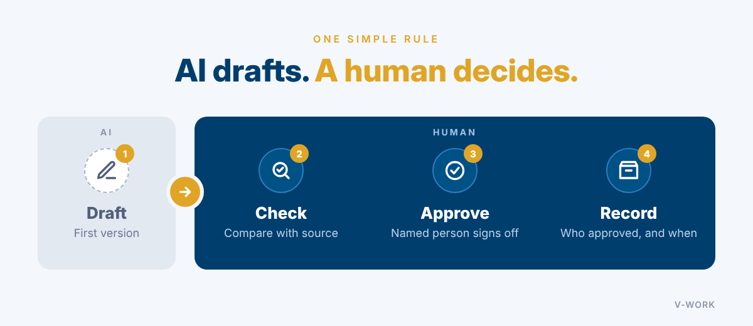
- AI helps write the first version.
- A person compares it against the source: the quotation, the contract, the data.
- A named person signs off before it goes to the client.
- The approved version is saved, with who approved it and when.
This is where good document management matters. When your files live in one proper system rather than scattered across email and WhatsApp, the checking and approval steps become part of the normal flow. With SharePoint document management, Malaysian teams can keep every version of a file, see who changed what, and add an approval step before a document is final. If a mistake ever slips through, you can trace exactly where it happened, so the conversation becomes “how do we fix the step” instead of “who do we blame.”
Three Questions to Ask Your Team This Week
Before rolling out any AI solution in Malaysia, agree on three things with your team:
- Which documents can AI help with, and which can’t it touch? An internal meeting summary is low risk. A tender submission or contract is high risk.
- Who checks, and who approves? Put a name to each type of document, not just “the team.”
- Where is the final, approved version kept? If the answer is “somewhere in someone’s email,” that’s your first problem to fix.
The Bottom Line
AI is a powerful helper, but it’s still a helper. The responsibility stays with your people, so the smartest move is to make that responsibility clear before something goes wrong rather than after.
Used this way, AI doesn’t create blame. It saves your team time on the first draft, and your people spend that time where it matters most: making sure it’s right.